Showing posts with label J. M. Boice. Show all posts

Sunday, November 11, 2007

3 Qutoes on Discipleship

In the past few days a couple of books about discipleship have arrived in the mail. The first was Bill Hull's Choose the Life. I gobbled that one down pretty quickly. It is not exactly the book I was looking for, but it definitely got me thinking. Hull writes:
Dietrich Bonhoeffer said, "Christianity without discipleship is always Christianity without Christ." Enough of the church has adopted a nondiscipleship Christianity to render it ineffective in its primary task--the transformation of individuals and communities into the image of Christ. This Christless Christianity has create leaders who are addicted to recognition and success and congregations that believe forsaking all things to follow Jesus is optional and a separate issue from salvation.
The latter part of Hull's book is directed at leaders and it becomes in some ways a typical "leadership" book, which I generally try to avoid like the plague.

The second book on discipleship is James Montgomery Boice's Christ's Call to Discipleship. This book came out back in 1986, so I suppose it ranks as a "classic" by now. Boice's opening paragraph:
There is a fatal defect in the life of Christ's church in the twentieth century: a lack of true discipleship. Discipleship means forsaking everything to follow Christ, but for many of today's supposed Christians -- perhaps the majority -- it is the case that while there is much talk about Christ and even more furious activity, there is actually very little following of Christ Himself. And this means in some circles there is very little genuine Christianity.
Those are stern and penetrating words -- the kind of words, in fact, that pierce to the very marrow. Just as an aside, I have come to think that we Christians have grown very shy of letting the Word of God pierce us in this way. How often do we really allow God to question us the way He questioned Job? And it so happens much of what Jesus had to say that was challenging and "piercing" had to do with discipleship.

As it happens, Boice also quotes Dietrich Bonhoeffer, who is famous for writing about (and paying with his own life) The Cost of Discipleship:
Costly grace is the treasure hidden in the field; for the sake of it a man will gladly go and sell all that he has. It is the pearl of great price, to buy which the merchant will sell all his goods. It is the kingly rule of Christ, for whose sake a man will pluck out the eye which causes him to stumble; and it is the call of Jesus Christ at which the disciple leaves his nets and follows him. Costly grace is the gospel which must be sought again and again, the gift which must be askedfor, the door at which a man must knock. Such grace is costly because it calls us to follow, and it is grace because it calls us to follow Jesus Christ.
I've just started reading the Boice book. After that I will probably move on to reread Bonhoeffer's classic. So you can guess what I'll be posting about in the near future.

Wednesday, October 25, 2006

Booksnip (3)


Here's another passage from James Montgomery Boice's expositional commentary on the Gospel of John:
It is true that no man can see God and live, as God said to Moses; but it is also true that in Christ God came to men in a way that enabled men to know him. In Jesus Christ the character of God may be known. There is no true knowledge of God apart from him. Do you want to believe that God is loving? Good! But do not base your belief on some fantasy of your imagination. What could be less reliable than that? Instead, base it on the revelation of God's love in Christ at Calvary. Do you want to believe that God is powerful, able to bring a transformation in your life? If so, do not depend on your own wishful thinking. Look to Jesus Christ. He will reveal it; because the same one who died for your sin also rose again in power and now lives to apply that same death-conquering power to the lives of those who follow him. Are you searching for wisdom? Look to the One who has become for us wisdom from God--that is, "our righteousness, holiness, and redemption." (1 Cor 1.30)
From The Gospel of John, Volume 1, by James Montgomery Boice, p. 101.

Sunday, October 22, 2006

Booksnip (2)


James Boice, in his discussion of John 1:13, says this:
The Biblical doctrine of rebirth takes everything away from man and gives everything to God. It is the principle of the "seesaw" in theology. It is the principle that you cannot have both ends of the seesaw--God and man--up at the same time.... If you exalt man in your thinking so that he is able to take care of himself spiritually and eventually inch his way into heaven, then God will be down and there will not be much need for him. But if man is down where he should be and where the Bible places him, dead in trespasses and sin, with a depraved will and utterly without any genuine spiritual potential, the God will be up where he belongs. He will be great and mighty and altogether lovely, as he is. And the Christian, when he comes to see these things, will look up from the dung heap of this world, still covered with much of the world's refuse, and say, "Oh, my God, how could you love me?" And when he gets to that point the love of Christ will begin to constrain him, and he will begin to learn that God has set things up this way so that it will be with the bonds of love and not the whip of the law that we are drawn to holiness through the Lord Jesus Christ.
From The Gospel of John, Volume 1, by James Montgomery Boice, p. 83.

Wednesday, October 11, 2006

Books, Books, Books!

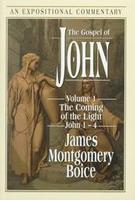
Back in the 80s the late James Montgomery Boice wrote an "expositional commentary" called The Gospel of John (in 5 volumes). I just purchased volume one, which covers the first four chapters of John's gospel. I think I'm really going to like it, too. Boice is a lucid expositor of the Scriptures. He simply shines a light on the Scriptures, always focusing on the main things, the important things. No flighty applications, no "prophetic" tangents. Good stuff here.

Speaking of books, have you seen top 50 books that have shaped Evangelicals? Interesting list. Many excellent books on this list, and some that I wish had not been quite so influential. Good to see A Wrinkle in Time at #20, And Elisabeth Elliot's wonderful Through Gates of Splendor at #9, far above (in the estimation of the compilers of this list, anyway) Left Behind (#36) and PDL (#42).

Anyway, I have to admit I was surprised by the choice for #1: Rosalind Rinker's Prayer: Conversing with God. This book has been collecting dust in my bookcase for some time. Perhaps I should read it, no?